
Where the Desert Meets the Sea: The Untamed Soul of La Guajira, Colombia (2026)
In 1499, Spanish explorer Alonso de Ojeda first sighted the stark, arid peninsula, naming it “La Guajira” after the indigenous people he encountered. For centuries, the Wayuu, the continent’s largest indigenous group, resisted. Their most legendary figure, the cacique Jepirra, didn’t just fight; he outsmarted. He famously negotiated a treaty with the Spanish Crown in 1769 that recognized Wayuu autonomy—a rare and enduring victory of wit over weaponry that still defines the region’s fierce independence.
The Story Behind La Guajira, Colombia
To understand La Guajira is to understand a land that has always defied conquest. Long before borders were drawn, the Wayuu people, descendants of the Arawak, navigated this harsh landscape, creating a matrilineal society of complex clans and oral law. The Spanish arrival in the 16th century marked the beginning of a resistance so formidable it became known as “La Guerra de los Wayuu.” While the rest of the continent fell, this peninsula remained a stubborn, unconquered territory. The Spanish built forts like La Villa de San Juan Bautista de la Guajira, but their control was tenuous at best, constantly challenged by Wayuu warriors and the land’s own unforgiving nature.
The 20th century brought a different kind of invasion: commerce. The discovery of vast coal deposits at Cerrejón, one of the world’s largest open-pit mines, in the 1980s transformed the region’s economy and landscape, creating a stark juxtaposition of ancient tradition and industrial might. Meanwhile, the northernmost tip, Punta Gallinas, became a crossroads for a different trade—smuggling. Its remote coves have seen everything from contraband electronics to, in darker times, narcotics, weaving a complex narrative of isolation, survival, and informal economies. This layered history—of indigenous resilience, colonial frustration, and modern extraction—is the bedrock upon which contemporary La Guajira stands, a place where the past is never buried by the shifting sands.
Neighborhood by Neighborhood
Riohacha’s Malecón & Centro
Riohacha, the departmental capital, is your gateway, and its soul is the breezy Malecón. Here, you’ll spend evenings watching the sun melt into the Caribbean as fishermen haul in their nets. The air carries the scent of fried fish and salt. Just inland, the Plaza Padilla centers the old town, anchored by the simple, white-washed Catedral de Nuestra Señora de los Remedios. The real magic, however, is in the side streets where you’ll find the Mercado Artesanal. Under a sprawling roof, Wayuu women, known as wayuunaiki, sit before vibrant displays of their legendary mochilas (handwoven bags) and chinchorros (hammocks), each intricate pattern a story passed through generations. This is not just a market; it’s a living museum of symbolism and skill.
Uribia: The Indigenous Capital
Venture an hour east into the desert, and you’ll arrive in Uribia, proudly declared the “Indigenous Capital of Colombia.” The atmosphere shifts palpably. You’re no longer in a Caribbean coastal town but in the heart of Wayuu territory. The streets are a dusty palette of ochre, lined with simple cinderblock homes often painted in bright blues and yellows. Don’t expect grand architecture; the beauty here is human. You’ll see women in flowing, colorful mantas navigating on motorcycles, their faces often shielded by wide-brimmed hats. The central market is the place to feel the pulse, where bartering for fresh goat meat, local cheese (queso costeño), and woven goods is conducted in a mix of Wayuunaiki and Spanish. It’s a raw, authentic, and humbling immersion.
Cabo de la Vela: The Spiritual Shore
Further north, the landscape opens into a surreal dreamscape at Cabo de la Vela. This small fishing village is a place of profound spiritual significance for the Wayuu, who believe it’s where souls depart for the afterlife. The scenery is breathtakingly stark: giant cardón cacti stand sentinel over windswept dunes that plunge into turquoise waters. The main “street” is a sandy path dotted with rustic guesthouses called posadas, like the beloved Posada Jarrinapi. Your days are spent climbing the Pilón de Azúcar, a rocky hill with a shrine at its peak offering 360-degree views, or kitesurfing in the constant, reliable winds at Playa Ojo de Agua. At dusk, every traveler gathers at El Faro (the lighthouse) to witness a sunset so violently beautiful it feels like a ceremony.
The Local Table: What Wayuu and Locals Actually Eat
In La Guajira, cuisine is a lesson in scarcity and ingenuity. This is not a land of abundant crops, but of hardy goats, resilient fish, and sun-baked earth. The diet is protein-heavy and straightforward, designed to sustain life in an extreme environment. The undisputed king of the table is friche. Don’t be fooled by its simple description—fried goat. This is a ritual. The goat is cooked in its own fat with salt, sometimes a bit of onion, until the meat is tender and the skin crisps into golden chicharrón. It’s served with arepa de huevo (a thick corn cake with an egg inside) and a slice of queso costeño, a hard, salty cheese perfect for grating.
For the freshest taste of the sea, savvy visitors head to the makeshift shacks along the beach in Cabo de la Vela or Riohacha’s Malecón. At Restaurante Donde Mónica in Cabo, you point to the day’s catch—likely red snapper (pargo) or lobster—and it’s grilled simply over coals and served with coconut rice and fried plantains. The true communal experience, however, is sharing a sancocho de guandú, a hearty stew of pigeon peas, meat, and vegetables, often prepared for family gatherings. It’s a dish that embodies the resourceful, communal spirit of surviving—and thriving—in the desert.

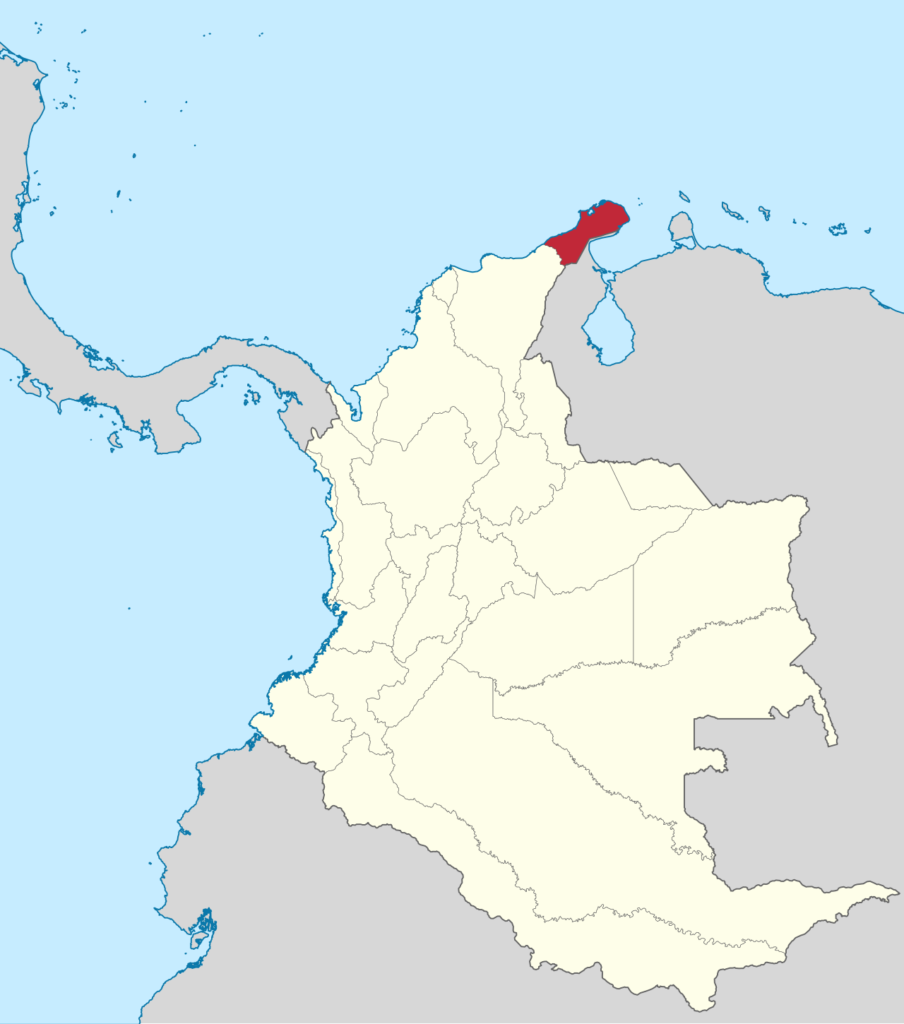
Localización de la Intendencia de La Guajira en la República de Colombia (1928), La Guajira, Colombia
Art, Music & Nightlife
The creative expression of La Guajira is woven into the fabric of daily life, not confined to galleries. The most iconic art is wearable: the mochila wayuu. Each bag can take up to a month to weave, its geometric patterns (kanaas) representing elements from nature, dreams, and clan lineage. To appreciate this, visit the workshop of master weavers in the communities surrounding Uribia. Music is dominated by the melancholic, accordion-driven sounds of Vallenato, born in neighboring Cesar but felt deeply here. During the Festival de la Cultura Wayuu held in Uribia every August, you’ll experience this fusion firsthand, with traditional yonna (the rain dance) performances alongside modern Vallenato concerts under the vast desert sky.
As for nightlife, forget neon-lit clubs. In Riohacha, your evening revolves around the Malecón, where open-air bars like La Cueva del Pirata serve cold Aguila beers as local bands play. In Cabo de la Vela, nightfall means gathering in your posada around a bonfire, strumming guitars, and swapping stories with other travelers under a blanket of stars so dense it feels tangible. The “party” is the profound silence of the desert, punctuated by laughter and the crackle of firewood.
Practical Guide
- Getting There: Fly into Almirante Padilla International Airport (RCH) in Riohacha via Avianca or LATAM from Bogotá or Medellín. For better connections, many travelers fly into Simón Bolívar International Airport (SMR) in Santa Marta and take a 2.5-hour shuttle (approx. 60,000 COP / $15 USD). Book flights at Skyscanner
- Getting Around: For Riohacha/Uribia, use local taxis (short rides ~8,000 COP). To explore the peninsula, you must hire a 4×4 with a driver/guide. A 3-day/2-night tour from Riohacha to Cabo de la Vela and Punta Gallinas costs 800,000 – 1,200,000 COP ($200-$300 USD) per person, including meals, lodging, and guide. Shared jeeps to Cabo from Uribia cost about 40,000 COP.
- Where to Stay: In Riohacha, the Hotel Taroa offers modern comfort. In Cabo de la Vela, embrace rustic charm at Posada Jarrinapi or Hospedaje Pujurú (approx. 50,000 COP/night with meals). For Punta Gallinas, lodgings are basic community-run posadas included in tours. Check Booking.com for Riohacha options.
- Best Time: December to April (dry season) for reliable access to remote areas. Avoid October-November, the peak of the rainy season, when roads become impassable.
- Budget: A mid-range, guided tour experience will run 150,000 – 250,000 COP ($40-$65 USD) per day, all-inclusive. Independent travel in Riohacha is cheaper, but the deep desert requires a tour.

Assorted-color hammocks under wooden shed beside sea, La Guajira, Colombia
What Surprises First-Time Visitors
The first surprise is the sheer, otherworldly beauty of the landscape. Photos don’t prepare you for the scale of the Dunas de Taroa, where you sprint down towering golden sand dunes directly into the crashing blue sea. It’s a geographical paradox that feels miraculous. Secondly, travelers often arrive expecting poverty and hardship (which is very real and should be approached with respect), but they leave speaking of profound human warmth. The Wayuu culture is deeply hospitable. An invitation to share a simple meal or a moment of shade is common, offering a connection that transcends language.
Finally, the silence. Beyond the villages, the desert offers a quiet so complete it becomes a sound of its own. At night in Punta Gallinas, with no light pollution, the Milky Way is a bright, dusty smear across the sky, and the only noise is the wind and the distant surf. This profound stillness, in a country often associated with vibrant noise, is La Guajira’s most unexpected and luxurious gift.
Your La Guajira, Colombia Questions
Is it safe to travel to La Guajira? The main tourist routes to Cabo de la Vela and Punta Gallinas, when traveled with a reputable local guide, are generally safe. Guides know the communities and territories. However, independent exploration off these routes is not advised due to the complex social landscape and extreme environment. Safety comes from respecting local knowledge, traveling in daylight, and using established tour operators.
How should I interact with the Wayuu community? Always ask permission before taking photographs of people. A simple “¿Foto, por favor?” goes a long way. Bartering for crafts is expected, but do so with a smile and respect—this is their livelihood, not a game. Buying a mochila directly from a weaver supports her family directly. Most importantly, approach with an open mind and heart; you are a guest in a culture that has survived against all odds.
What is one essential item to pack? Beyond sunblock and a hat, pack cash (Colombian Pesos). ATMs are scarce outside Riohacha and Uribia, and credit cards are useless in the desert communities. Bring more than you think you’ll need in small denominations for handicrafts, snacks, and tips. Also, pack a headlamp, as electricity in remote posadas is often limited to a few hours by generator.

Amazing view of distant kite surfer practicing on blue sea near moored old …, La Guajira, Colombia

