
Where the Spirit Dances: Immersion in the Highlands Heart of Tari, Papua New Guinea (2026)
In 1935, Australian prospector Michael Leahy, the first European to enter the Tari Basin, stood awestruck. Before him, men adorned with iridescent bird-of-paradise plumes and faces painted in ochre and white clay performed a thunderous, rhythmic welcome. This moment, captured in his journals, was not a discovery of a place, but the world’s introduction to the Huli Wigmen—a culture whose intricate traditions had flourished in isolation for millennia, and whose community in Tari remains the vibrant custodian of that legacy today.
The Story Behind Tari’s Community, Papua New Guinea
The history of Tari is not written in stone monuments, but woven into the wigs of its men and sung in the stories of its clans. For over a thousand years, the Huli people have shaped these fertile highland valleys, their society structured around complex kinship and a profound connection to the land. Their history is an oral tapestry of migrations, clan alliances, and the “Great Fight” traditions that settled disputes long before outside contact. The arrival of Leahy and later, missionaries and government patrols in the mid-20th century, marked a sudden collision with the modern world, but one the Huli navigated with remarkable cultural resilience.
Unlike many parts of Papua New Guinea, Tari experienced no colonial plantation economy. Its turning point was the establishment of a government station and airstrip in the 1960s, which drew the scattered clans closer together. The discovery of the massive Hides gas field nearby in the 1980s brought new infrastructure and complexities, but the core of Huli identity held firm. Today, Tari is the administrative center of Hela Province, a bustling hub where men in traditional wigs and *lap-laps* (loincloths) conduct business beside those in trousers, a living testament to a culture that consciously chooses to maintain its core amidst change. Travelers discover that history here is not a relic; it’s a daily practice, a conscious decision to wear, sing, and live the ways of the ancestors.
Neighborhood by Neighborhood
Tari Station: The Beating Heart
This is the administrative and commercial nucleus, a lively sprawl of government buildings, trade stores, and the bustling market. The air hums with the sound of PMVs (Public Motor Vehicles) loading up, and the scent of roasting sweet potato mingles with diesel. Your best bet for people-watching is near the market, where mounded piles of vibrant produce—kaukau (sweet potato), taro, and pitpit—are sold by women in colorful meri blouses. Key spots include the small airstrip, where the twice-daily flight from Port Moresby is a major event, and the Provincial Headquarters. The architecture is functional, but the real character comes from the street life: a vivid, sometimes chaotic, tableau of modern Papua New Guinea where the famed Huli Wigmen are not performers for tourists, but locals going about their day.
Koroba Road Environs: The Cultural Corridor
Heading out from the station along the Koroba Road, the landscape softens into a corridor of guesthouses, church compounds, and family homesteads surrounded by meticulously kept gardens. This area offers a more residential feel and is where many cultural tour operators and guides are based. The character is one of transition, between the town’s bustle and the deep village life. You’ll find the renowned Ambua Lodge about a 30-minute drive away, perched on a ridge with breathtaking valley views. Locals recommend taking slow walks along the roadside here in the late afternoon, when the light turns golden and you can observe daily life: children returning from school, men tending to their wig schools (*Hausman*), and the ever-present chorus of birds.
The Village Network: The Living Tradition
Tari’s true soul lies not in a single neighborhood, but in the network of villages that radiate from the station—places like Tagali, Pori, and Yaluba. Accessible only by 4WD or on foot via muddy tracks, these are the keepers of tradition. Here, architecture is purely traditional: round houses with kunai grass roofs, and the sacred *Hausman* where boys live in seclusion for up to 18 months to learn the ways of manhood and grow their ceremonial wigs. The sensory experience is profound: woodsmoke, the rich earth, the sound of *kundu* drums, and the visual spectacle of men whose wigs, sometimes over a meter wide, are decorated with flowers, feathers, and cuscus fur. Visiting these villages requires an invitation and a guide, but it is here that you move from observing a culture to being respectfully enveloped by it.
The Local Table: What the Huli Actually Eat
The cuisine of Tari is a direct expression of its highland environment: hearty, earthy, and centered on the garden. The Huli are master horticulturalists, and the staple is the kaukau (sweet potato), which comes in purple, yellow, and white varieties. It’s roasted in open fires, boiled in clay pots, or baked in mumu (ground ovens) with other greens. Protein comes from the generous forests: wild pig, cassowary, and the marsupial cuscus are traditional festival foods. On a daily basis, you’ll find river fish and, increasingly, tin fish (canned mackerel) from the trade stores. Vegetables like aibika (leafy greens), corn, and pitpit (a local asparagus-like shoot) are ubiquitous.
Travelers must seek out the experience of a mumu. This is not just a cooking method but a social event. Stones are heated in a fire, then layered with banana leaves, meat, kaukau, and greens. The whole bundle is sealed with more leaves and earth to steam for hours. The resulting meal is incredibly succulent and smoky. For a taste of daily market fare, head to the Tari Main Market in the early morning. Look for simple stalls selling roasted kaukau (about PGK 2, or $0.50 USD) or bowls of hearty pumpkin soup. A family-run spot like Linda’s Kitchen near the station offers simple, clean plates of rice, chicken, and greens for around PGK 15-20 ($4-5 USD), giving you a reliable taste of local home cooking.

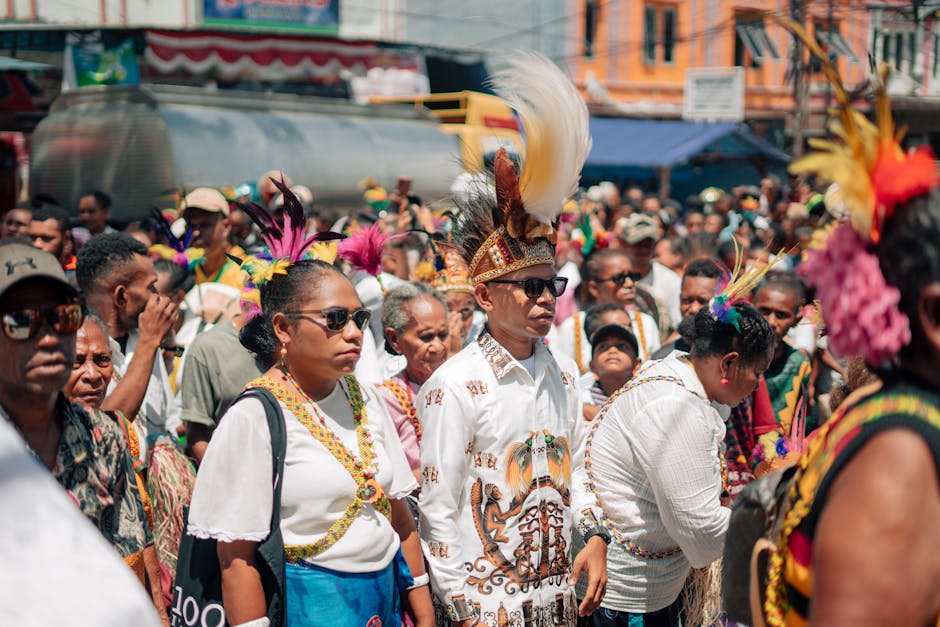
A senior woman stands smiling amidst vibrant traditional Papua New Guinean …, Tari’s Community, Papua New Guinea
Art, Music & Nightlife
The creative pulse of Tari is its sing-sing culture. This is not nightly entertainment, but profound ceremonial expression. The most spectacular is the Huli Wigmen sing-sing, where dozens, sometimes hundreds, of men adorned in their full regalia—woven wigs, face paint in yellow ochre and red, belts of leaves, and bird-of-paradise plumes—perform rhythmic, stomping dances to the deep-throated call of kundu drums and chanting. The synchronized movement and visual impact is breathtaking. While major performances are often tied to festivals like the Tari Show (usually in August) or Independence Day (September 16), smaller, more spontaneous sing-sings occur in the villages for bride price ceremonies or dispute resolutions.
For nightlife in a Western sense, Tari is quiet. After dark, the social life retreats to family homes and guesthouse common areas. However, the real “art scene” is on the bodies of the people. The intricate self-decoration is a living art form. Savvy visitors know to spend time learning about the symbolism: the colors of the face paint, the types of feathers (from the Raggiana or Superb Bird-of-Paradise), and the cassowary-bone daggers and woven bilum bags that are both art and utility. Your “gallery” is the market and the village clearing, where this art is worn with pride every day.
Practical Guide
- Getting There: Fly from Port Moresby (POM) to Tari (TIZ) on PNG Air or Air Niugini. Flights are 1-1.5 hours but are weather-dependent and book out fast. Expect to pay PGK 400-600 ($110-170 USD) one-way. Book at Skyscanner
- Getting Around: On foot in the station. For villages, hire a 4WD with driver/guide through your lodge or tour operator. Costs are PGK 300-500 ($85-140 USD) per day. PMVs are cheap (PGK 5-10) but crowded and unpredictable.
- Where to Stay: For comfort, the iconic Ambua Lodge (PGK 600-800/night, all-inclusive) is unparalleled. In Tari Station, Tari Country Lodge offers basic, clean rooms (PGK 250-350/night). Check Booking.com for limited listings, but often direct booking is required.
- Best Time: The dry(er) season from May to October. Rains are lighter, roads are more passable, and major festivals occur. Avoid the peak wet season (Dec-Mar) when flights are heavily disrupted.
- Budget: A realistic daily budget for a guided, comfortable experience is PGK 800-1200 ($220-330 USD) per person, covering lodge, meals, guide, and transport. Independent budget travel is extremely challenging here.
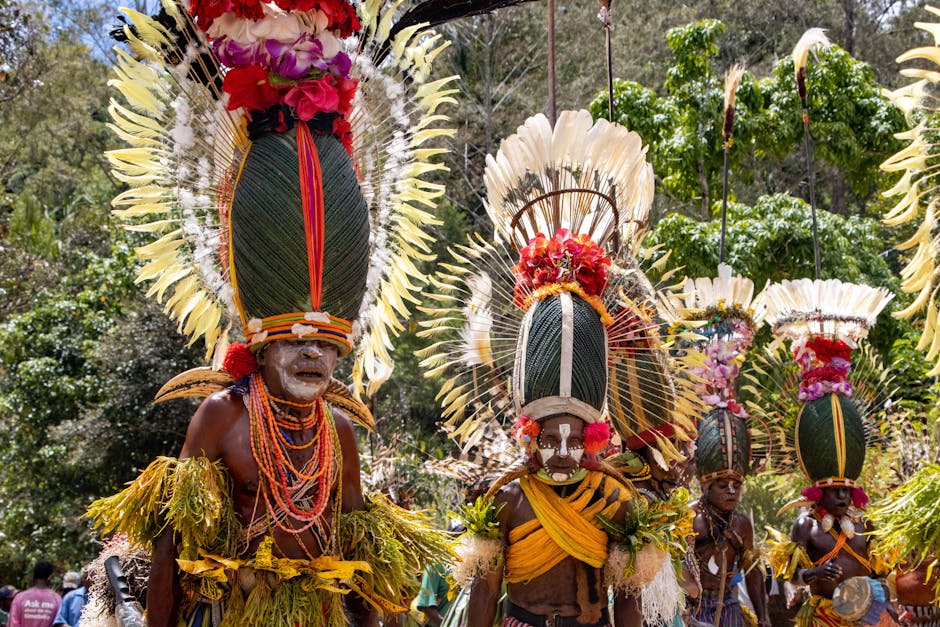
Colorful tribal dancers in traditional attire at a cultural festival in Pap…, Tari’s Community, Papua New Guinea
What Surprises First-Time Visitors
Many travelers arrive expecting a “primitive” culture frozen in time and are immediately surprised by the sophisticated agency of the Huli people. You’ll discover men who can discuss global politics or natural gas economics one moment, and then meticulously apply traditional face paint the next. The choice to maintain the wigmen tradition is just that—a conscious, proud choice, not a lack of alternatives. This blurring of epochs is constant and thought-provoking.
The other profound surprise is the intensity of the welcome. While Tari has a reputation for tribal tensions (which are very real and require careful guidance to avoid), within the context of a properly arranged visit, the hospitality is overwhelming. Visitors are often taken aback by the genuine curiosity and warmth extended to them. You are not just a spectator; you are a guest, invited to share food, laughter, and stories. The misconception of a cold or hostile reception is quickly dissolved by the open smiles and eager attempts at communication, often through a mix of Tok Pisin, Huli, and expressive gesture.
Your Tari’s Community, Papua New Guinea Questions
Is it safe to travel to Tari independently? The unanimous advice from experienced guides and the PNG Tourism Authority is no. Tari is not a destination for solo backpacking. Tribal conflicts (*raskolism*) can flare up unpredictably. Your safety and a respectful, meaningful experience are entirely dependent on using a reputable, locally-owned tour operator or lodge (like Ambua Lodge) who provide expert guides, understand the complex clan dynamics, and can secure safe passage and invitations to villages. This is non-negotiable.
How do I visit a wig school (*Hausman*)? Access is strictly by invitation and arranged through your guide. It is a sacred male space. Visitors must follow strict protocols: usually, a small gift of tobacco or money (PGK 20-50) is offered to the master, photography may be restricted or require an additional fee, and women are almost never permitted to enter the school itself, though they may observe from a distance. The boys are in a serious period of learning and initiation; travelers must be respectful, quiet, and follow their guide’s lead explicitly.
What should I absolutely pack? Beyond general trekking gear, pack for mud: sturdy, ankle-supporting waterproof boots are essential. Include quick-dry clothing, a high-quality rain jacket, a headlamp, and plenty of baby wipes. Crucially, bring small, thoughtful gifts for hosts: packets of tobacco (a traditional currency), betel nut (if you know it’s used there), or useful items like bush knives, seeds, or simple children’s toys. Avoid flashy jewelry or expensive electronics. Most importantly, pack immense patience and flexibility—schedules in the Highlands are dictated by weather, community events, and flight reliability, not the clock.

Tribal warrior with body paint and bow in Jayapura’s lush jungle., Tari’s Community, Papua New Guinea

