
Ksour Essef, Tunisia: Ancient Granaries, Olive Groves & Living Heritage (2026)
In 1905, a French colonial administrator, marveling at the intricate gold filigree work emerging from a small workshop, declared Ksour Essef’s jewelry the finest in the protectorate. This external validation was nothing new for the town; for centuries, its artisans had been quietly perfecting a craft that would become its heartbeat, weaving precious metals into a legacy as enduring as the ancient stones of its medina.
The Story Behind Ksour Essef, Tunisia
Ksour Essef’s story is not one of dramatic conquests or fallen empires, but of steady, skilled hands and strategic crossroads. Founded in the 15th century by Andalusian refugees fleeing the Reconquista in Spain, the town was built upon older Berber settlements. These newcomers brought with them not just a longing for a lost homeland, but advanced techniques in agriculture, architecture, and, most famously, metallurgy. They found a land ripe for olive cultivation and a location along vital caravan routes connecting the Saharan interior to the coastal ports of Mahdia and Sfax.
This confluence of skill and trade shaped its destiny. By the 17th and 18th centuries, Ksour Essef had solidified its reputation as a premier center for goldsmithing and jewelry-making in the Sahel region. Its souks hummed with the sounds of hammers on anvils, and its designs—a fusion of Andalusian geometry, Ottoman influence, and Berber symbolism—became highly sought-after, traditionally forming the cornerstone of a bride’s dowry. The town’s very name hints at this layered history: “Ksour” refers to the fortified granaries (ksars) of the Berbers, while “Essef” is believed to derive from the Arabic for “threshold” or “wall,” speaking to its role as a gateway.
Neighborhood by Neighborhood
The Ancient Medina: A Labyrinth of Craft
Step through one of the old arched gateways, and you leave the 21st century behind. The medina is a compact, living museum of vaulted passageways (sabats) and sun-dappled courtyards. Your senses are immediately engaged: the faint, tangy scent of metal polish, the rhythmic *tap-tap-tap* from dimly lit workshops, and the glitter of gold threads in display cases. The main thoroughfare, lined with tiny, family-run ateliers, is where you’ll witness masters, often third or fourth-generation, bending over their workbenches with magnifying glasses strapped to their heads. Look up to see beautiful examples of Spanish-Arab architecture in the doorframes and the occasional *moucharabieh* (wooden lattice) window. This isn’t a neighborhood for grand monuments; its treasure is the daily, dedicated act of creation.
Hara Kebira: The Pulse of Daily Life
Just beyond the medina’s walls lies Hara Kebira, the “Big Quarter.” Here, the focus shifts from craft to community. The streets are wider, lined with modest whitewashed houses adorned with sky-blue doors—a color said to ward off the evil eye. This is where you’ll find the vibrant daily market, a cacophony of vendors selling fresh produce, spices piled in colorful cones, and the catch of the day from the nearby coast. In the late afternoon, the air fills with the aroma of baking bread from communal ovens. Life here unfolds on doorsteps and in small cafes where men play endless games of *Ronda*. It’s a neighborhood of quiet observation, where your best bet is to find a bench, sip a strong coffee, and watch the unhurried rhythm of local life.
The New Ville: Where Tradition Meets Modernity
Radiating out from the old core, the New Ville represents Ksour Essef’s contemporary face. Broad, tree-lined avenues like Avenue Habib Bourguiba are flanked by administrative buildings, banks, and modern jewelry shops with gleaming vitrines. The contrast with the medina is stark, but the connection remains. Here, the intricate filigree pieces crafted in the old town are sold in polished settings. You’ll find cybercafés next to shops selling traditional *chechias* (red felt hats). This area comes alive on Friday evenings, with families strolling and young people gathering in cafes. It’s a testament to a town that honors its past without being trapped by it.
The Local Table: What Ksour Essef Natives Actually Eat
The cuisine here is a hearty reflection of its Sahelian roots—robust, flavorful, and deeply connected to the land and sea. Olive oil from surrounding groves is the liquid gold of every kitchen. While couscous is the Friday staple, the daily fare often centers on fish stews and slow-cooked meats. Locals eat with the seasons and the sun: a light breakfast of *fricas* (fried dough) with honey, a substantial lunch after the midday heat breaks, and a lighter dinner.
One dish you must seek out is **Mloukhia Mahdawia**. This isn’t the green mloukhia stew found elsewhere, but a unique regional specialty from nearby Mahdia. It’s a rich, dark stew made from dried jute leaves, garlic, and a generous amount of olive oil, typically served over stale bread and topped with fresh fish or lamb. The texture is velvety and the flavor deeply umami. For an authentic taste, head to the unassuming **Restaurant El Medina** near the old town. Don’t be fooled by the simple decor; by 1:30 PM, it’s packed with locals savoring this defining dish for about 12-15 TND per person.

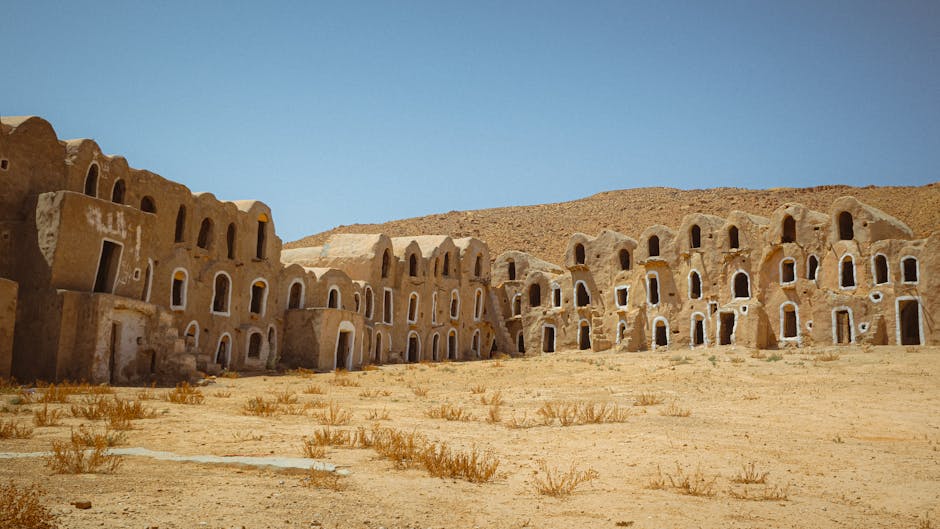
Discover ancient Ksour architecture in the sunlit landscapes of Tataouine, Ksour Essef, Tunisia
Art, Music & Nightlife
In Ksour Essef, art is not confined to galleries; it’s worn on the body. The primary artistic expression remains the jewelry—each piece a miniature sculpture. However, travelers with a keen eye will find other traditions. Look for vibrant, hand-embroidered *jebbas* (traditional tunics) and woven textiles in the market. The musical heritage is tied to the wider Sahel region, with **Malouf**—a classical Andalusian-derived style—performed at weddings and celebrations. You might hear its melancholic strings and poetic lyrics drifting from a family courtyard during a festival.
For nightlife, forget buzzing clubs. Evening entertainment is social and communal. In the warmer months (April-October), the **Festival of Traditional Jewelry** illuminates the town, usually in July. The old medina becomes a stage for craft demonstrations, folk music, and parades showcasing heirloom pieces. On any given night, your most memorable experience will be joining locals in a café on the main avenue for mint tea, watching the world go by under a canopy of stars, the day’s last sounds being laughter and the clink of tea glasses.
Practical Guide
- Getting There: Fly into Monastir Habib Bourguiba International Airport (MIR) or Enfidha-Hammamet Airport (NBE). From there, take a 90-minute taxi (approx. 60-80 TND) or a *louage* (shared minivan, approx. 10 TND) to Ksour Essef. Book flights at Skyscanner
- Getting Around: The town is wonderfully walkable. For trips to nearby beaches like Salakta or ancient sites, yellow taxis are cheap (5-10 TND within town) or negotiate a half-day rate (around 50 TND).
- Where to Stay: Opt for a traditional guesthouse (*dar*) in or near the medina for atmosphere. The New Ville offers more modern, basic hotels. Check availability at Booking.com
- Best Time: **April-June** and **September-October**. The weather is ideal (20-28°C), and you’ll avoid the intense summer heat and crowds.
- Budget: A comfortable daily budget is 120-150 TND (≈ $40-50 USD). This covers a modest guesthouse, local meals, transport, and a small souvenir.

Explore Tunisia’s traditional Berber architecture with warm stone and uniqu…, Ksour Essef, Tunisia
What Surprises First-Time Visitors
The first surprise is the profound quiet and lack of tourist hustle. You won’t be besieged by shop touts. Instead, artisans are often so engrossed in their work they might not immediately look up, offering a rare, unperformed glimpse into their world. This respectful silence feels more like an invitation to observe than a dismissal.
Secondly, travelers discover an incredible openness behind initial reserve. If you show genuine interest in the craft—perhaps by asking about a specific tool or technique—a wall comes down. You might be beckoned into a workshop for a closer look, offered a glass of tea, and hear stories of the trade passed from father to son. The pride here is deep and personal, not commercial. The beauty of Ksour Essef isn’t just in what is made, but in the palpable continuity of how and why it’s made.
Your Ksour Essef, Tunisia Questions
Is it safe to buy gold jewelry here? Absolutely, and it’s a primary reason many Tunisians visit. The gold is high quality (often 18 or 21 karat) and sold by weight with a modest workmanship fee. Reputable shops provide weight tickets. Savvy visitors know to visit several workshops to compare styles and prices before deciding. Always negotiate politely; it’s expected.
Can I do a day trip from Sousse or Mahdia? Yes, easily. Ksour Essef is about a 45-minute drive from Mahdia and 75 minutes from Sousse. A day gives you ample time to explore the medina, have lunch, and visit workshops. However, staying one night allows you to experience the serene evening atmosphere after day-trippers leave.
What should I wear as a respectful visitor? While Tunisia is relatively liberal, Ksour Essef is a traditional, working town. Both men and women should opt for modest clothing that covers shoulders and knees. This shows respect for local customs and will make your interactions, especially when entering workshops or speaking with older artisans, much more comfortable and welcomed.

Historic Roman amphitheater in El Jem, Tunisia, showcasing ancient architecture., Ksour Essef, Tunisia
Explore More Destinations
- Jozani, Tanzania on a Budget: an Ancient Forest for $35/Day (2026)
- Nsumbu, Zambia on a Budget: Wild Africa for $40/Day (2026)
- Semporna, Malaysia on a Budget: Paradise for $35/Day (2026)
- Khuzestan, Iran on a Budget: Ancient Empires for $30/Day (2026)
- Ngerulmud, Palau on a Budget: Island Majesty for $45/Day (2026)
Ready to Visit Ksour Essef?
Start planning your trip today. Compare hotels, find the best tours, and get insider tips.
Your adventure in Ksour Essef starts here →
Related Guides
Explore more destinations similar to Ksour Essef:

