
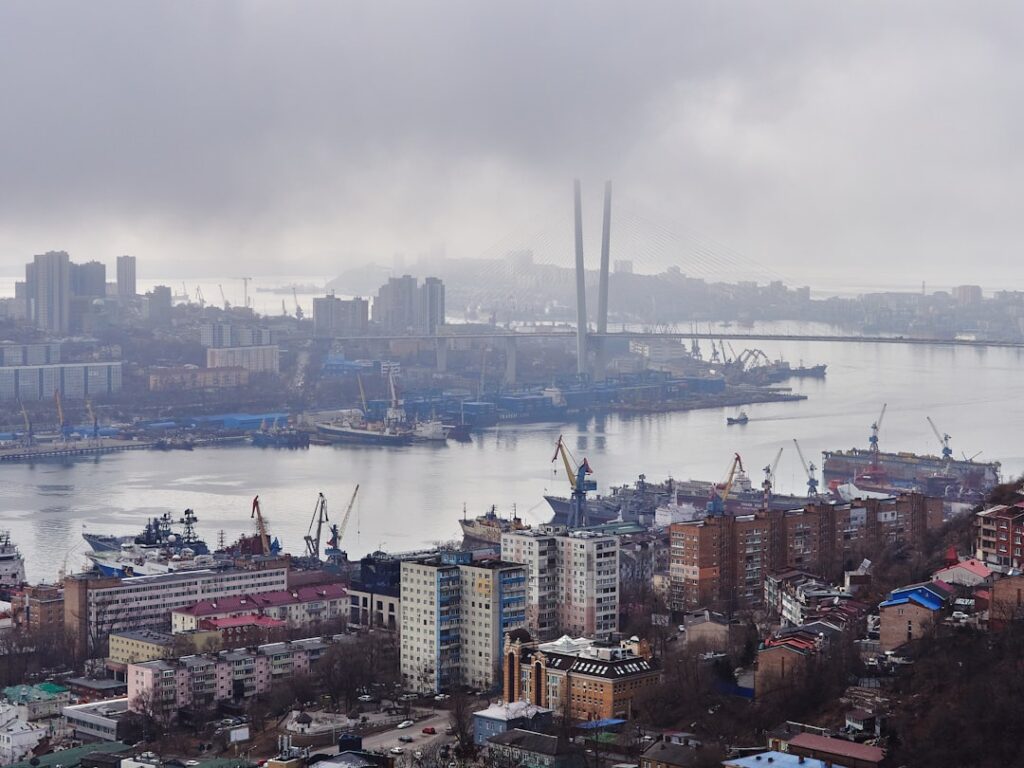
Vladivostok, Russia’s Amazing Bridges, Borscht & Pacific Frontier Spirit (2025)
Sunset over the Golden Horn Bay paints the 3,309-meter-long Russky Bridge in fiery hues, a modern colossus that would be the world’s longest cable-stayed bridge if not for one in China. This is Vladivostok, where the Trans-Siberian Railway meets the Pacific, a city of staggering engineering and tsarist-era forts that feels closer to Seoul or Tokyo than to Moscow. Here, you can stand on a cliff where a young Chekhov declared the Amur Bay “smiled,” and hours later, feast on king crab so fresh it was swimming that morning.
Why Vladivostok, Russia Stands Out

A large boat floating on top of a large body of water, Vladivostok, Russia
- Historic Architecture: The ornate Vladivostok Fortress Museum, a network of late 19th-century coastal batteries, whispers of the city’s strategic role as the “Lord of the East.”
- Cultural Scene: The annual Pacific Meridian International Film Festival each September transforms the city into a cinematic hub, drawing stars and directors from across Asia.
- Local Specialties: You must try krasnaya ikra (red salmon caviar) on a blini, a taste of the Pacific’s bounty that’s both luxurious and surprisingly affordable here.
Pro Tip: For the perfect blend of pleasant weather and vibrant city life, target the shoulder months of September or early October. You’ll avoid the peak summer tourist influx and the dense fog of late spring, while enjoying crisp, sunny days ideal for hiking the surrounding hills.
Map of Vladivostok, Russia
Use these interactive maps to explore Vladivostok, Russia and plan your route:
📍 View Vladivostok, Russia on OpenStreetMap
🗺️ Open Vladivostok, Russia in Google Maps
Planning Your Trip: Practical Essentials
Getting There and Around
- By Air: Vladivostok International Airport (VVO) is served by Aeroflot, S7, and several Asian carriers like Korean Air. A taxi to the center takes 45 minutes and costs ~1500 RUB. Book flights at Skyscanner for best deals.
- By Train: The legendary Trans-Siberian Railway terminates here after a 7-day journey from Moscow. The grand Vladivostok Railway Station, built in 1912, is an attraction itself. Reserve tickets at Trainline or the national railway website.
- By Car: Driving offers freedom to explore the Primorsky Krai coastline. Note: you’ll need special permits for some border areas. Compare car rentals at RentalCars.com.
- Local Transport: The city has an efficient bus, trolleybus, and funicular system. A single ride costs ~30 RUB. The funicular from Pushkinskaya Street to the Eagle’s Nest viewpoint is a must for the view alone.
Best Time to Visit
Vladivostok’s climate is a dramatic mix of humid continental and monsoon influences, meaning your experience varies wildly by season. Savvy travelers plan around both weather and local events.
| Season | Weather | Highlights |
|---|---|---|
| Summer (Jun–Aug) | Warm, 18-25°C (64-77°F), but often foggy and humid with occasional rain. | Vibrant street life, beach days at nearby islands, and sailing in the bay. This is peak season, so book ahead. |
| Winter (Dec–Feb) | Cold, dry, and sunny, -10 to -5°C (14-23°F). The sea partially freezes. | Breathtaking icy vistas, winter sports at nearby resorts, and a stark, beautiful atmosphere with few tourists. |
| Shoulder (Apr–May/Sep–Oct) | Spring is cool and foggy; Autumn is crisp, sunny, and clear, 10-18°C (50-64°F). | Ideal for hiking, photography (golden autumn leaves), and city exploration without crowds. The best overall time to visit. |
Budgeting for Vladivostok, Russia

Blue jellyfish floating in the dark water., Vladivostok, Russia
| Category | Budget | Mid-range | Luxury |
|---|---|---|---|
| Accommodation | Hostel dorm: 800-1200 RUB/night | 3-star hotel: 3500-5500 RUB/night | 5-star (Hyundai Hotel): 8000+ RUB/night |
| Meals | Stolovaya (cafeteria): 300-500 RUB | Local restaurant: 800-1500 RUB | Fine dining with seafood: 3000+ RUB |
| Transport | Public transport: 150 RUB/day | Taxis/Yandex: 500-800 RUB/day | Private driver: 3000+ RUB/day |
| Activities | Hiking, fortress ruins: Free | Museums, boat tours: 1000 RUB/day | Private yacht tour: 8000+ RUB |
| Daily Total | 2000-2500 RUB | 6000-8000 RUB | 15,000+ RUB |
Top Attractions and Must-See Sights
| Attraction | Description | Hours | Entry Fee |
|---|---|---|---|
| Russky Island & Bridge | Take in the awe-inspiring engineering of the bridge and explore the island’s pristine coves, Soviet-era ruins, and the modern Far Eastern Federal University campus. | Island access: 24/7 | Free (bridge crossing); Museum on island ~400 RUB |
| Vladivostok Fortress Museum | A sprawling open-air museum of coastal defense batteries, underground tunnels, and artillery pieces offering panoramic views and a deep dive into military history. | 10:00-18:00 (Wed-Sun) | ~300 RUB for main battery |
| Eagle’s Nest Hill | The city’s highest accessible viewpoint, reached by funicular, providing the definitive postcard panorama of the Golden Horn Bay, bridges, and bustling port. | Funicular: 7:00-20:00 | Funicular: ~20 RUB |
| S-56 Submarine Museum | Board a real WWII-era Soviet submarine moored on Korabelnaya Embankment, offering a claustrophobic but fascinating glimpse into naval life. | 10:00-19:00 | ~200 RUB |
3-Day Itinerary: Vladivostok, Russia’s Highlights & Hidden Gems
Day 1: Imperial History & Bay Views
- Morning (7-9 AM): Start at Sportivnaya Harbor to watch the fishing boats unload their catch. Then, take the historic funicular (20 RUB) up to Eagle’s Nest Hill for crowd-free morning views over the misty bay.
- Afternoon (12-3 PM): Walk down to the Vladivostok Fortress Museum at Battery No. 369. Spend a couple of hours exploring the tunnels. For lunch, head to Stolovaya No. 1 on Svetlanskaya Street for authentic, cheap Russian comfort food like borscht and pelmeni (~400 RUB).
- Evening (6-8 PM): Stroll along Korabelnaya Embankment, see the S-56 Submarine, and watch the city lights flicker on. Dinner at Morskoi offers solid Russian seafood like grilled scallops in a cozy, nautical setting (~1500 RUB).
Day 2: Islands & Engineering Marvels
- Morning (8 AM): Take a bus or taxi across the Zolotoy Bridge to Russky Island (bridge toll ~200 RUB by car). Hike to the secluded Cape Tobizina for dramatic cliffs and ocean views. Pack a picnic from a local market.
- Afternoon (1 PM): Visit the impressive campus of Far Eastern Federal University. Then, head to the quiet, sandy beach at Ayaks Bay for a breather. Return to the city by late afternoon.
- Evening (7 PM): Experience the vibrant food scene at Zuma, a top-rated Pan-Asian restaurant famous for its fresh seafood and dim sum. Reservations are essential (dinner ~2500 RUB).
Day 3: Culture, Markets & Departure
- Morning (9 AM): Explore the bustling Sportivny Rynok (market). This is where to buy vacuum-packed red caviar, smoked fish, and local honey as souvenirs. Practice your bargaining skills.
- Afternoon (12 PM): Visit the Arsenyev Regional Museum to understand the history and ethnography of Primorsky Krai. For a final lunch, try Pyaty Okean for their legendary “Far Eastern” salad with crab and a view of the harbor (~1200 RUB).
- Evening (5 PM): Make a final pilgrimage to the Vladivostok Railway Station. Stand at the “9288 km” marker—the terminus of the Trans-Siberian—and soak in the atmosphere of journeys begun and ended.
Cultural Insights & Etiquette
- Language: Russian is essential. Learn Cyrillic basics and key phrases: “Spasibo” (Thank you), “Zdravstvuyte” (Hello), “Skolko stoit?” (How much?). English is not widely spoken outside major hotels.
- Customs: A firm handshake is standard. When invited to a home, always bring a small gift (chocolates, wine, flowers—ensure an odd number). Remove your shoes at the entrance.
- Tipping: Not mandatory, but appreciated. In restaurants, 5-10% for good service is becoming common. Round up the taxi fare.
- Dress Code: Smart-casual is fine for most places. Pack layers and sturdy walking shoes for the hilly terrain. For upscale restaurants, neat attire is expected.
- Business Hours: Shops typically open 9:00-10:00 and close 19:00-21:00. Museums often have a weekly closing day (Monday or Tuesday). Banks close by 18:00.
Where to Eat: Vladivostok, Russia’s Best Bites
Vladivostok’s cuisine is a thrilling fusion of Russian heartiness and the incredible seafood bounty of the Pacific. Forget bland stereotypes; here, dining is about ultra-fresh crab, sea urchin, caviar, and Korean-influenced salads (morkovcha).
Must-Try Local Specialties
- Kamchatsky Crab: Steamed whole and served with melted butter. Best tried at the market or dedicated seafood restaurants like Okeanarium.
- Pelmeni with Seafood: A local twist on the classic dumpling, stuffed with minced fish or crab. Find them at traditional stolovayas.
- Blini with Red Caviar: The classic indulgence. For the best, buy fresh caviar at Sportivny Rynok and enjoy it simply on warm pancakes with sour cream.
Restaurant Recommendations by Budget
| Type | Restaurant | Specialty | Price Range |
|---|---|---|---|
| Budget | Stolovaya No. 1 (Svetlanskaya St.) | Authentic, no-frills Russian home cooking in a Soviet-era canteen setting. | 300-500 RUB |
| Mid-range | Morskoi (Korabelnaya Emb.) | Reliable Russian seafood classics with fantastic views of the harbor and submarines. | 1000-1800 RUB |
| Fine dining | Zuma (Fontannaya St.) | Elegant Pan-Asian fusion, renowned for its creative sushi, dim sum, and vibrant atmosphere. | 2500-4000 RUB |
Where to Stay
Accommodation clusters in the city center near Svetlanskaya Street for convenience, or on Russky Island for a quieter, nature-focused stay. Book well in advance for summer and major events. Compare prices and book at Booking.com or Airbnb for apartments.
Best Neighborhoods for Accommodation
- Tsentralny District (City Center): The heart of the action. You’re steps from museums, main squares, restaurants, and the waterfront. Best for first-time visitors who want to walk everywhere. Can be noisy at night.
- Sportivnaya Harbor Area: A slightly quieter but still central location near the funicular, markets, and the bay. Offers a more local, maritime feel with great seafood eateries nearby.
- Russky Island: For tranquility and nature. Ideal for hiking, beachcombing, and getting away from the urban buzz. Requires transport to reach the city sights. Choose this for a second visit or a retreat.

A close up of a starfish on a table, Vladivostok, Russia
FAQs: Your Vladivostok, Russia Questions Answered
1. Is Vladivostok, Russia safe at night?
The central areas are generally safe for travelers at night. As in any port city, exercise standard caution: stick to well-lit main streets, be aware of your surroundings, and avoid poorly lit parks or deserted areas late at night. Taxis (use the Yandex.Taxi app) are cheap and reliable for getting around after dark.
2. What currency is used and are credit cards accepted?
The Russian Ruble (RUB) is the currency. Credit/debit cards (Visa, Mastercard) are widely accepted in hotels, larger restaurants, and stores. However, you should always carry some cash for markets, smaller cafes, buses, and tips. ATMs are plentiful.
3. How do I get from the airport to the city center?
Vladivostok International Airport (VVO) is about 45 minutes north. The most convenient option is a pre-booked taxi or the Yandex.Taxi app (~1500 RUB). There is also public bus #107 to the city center, which takes about 90 minutes and costs under 100 RUB. Book airport transfers at GetYourGuide for convenience.
4. Do I need to speak the local language?
While you can manage in major hotels and some tourist restaurants with English, basic Russian phrases and the ability to read Cyrillic will vastly improve your experience. Locals appreciate the effort. Have a translation app (like Yandex.Translate) ready for menus and signs.
5. What’s the appropriate dress code?</
Related Guides
Explore more destinations similar to Vladivostok:
- Tombua, Angola: Ultimate Coastal Serenity, Portuguese Heritage & Atlantic Sunsets (2025)
- Durrës, Albania’s Epic Ancient Ruins, Riviera Beaches & Unbeatable Value (2025)
- How to Discover Salento’s (colombia) Most Stunning Hidden Gems
- Magburaka, Sierra Leone: Ultimate Authentic Culture, Historic Charm & Untouched Nature (2025)
{“@context”: “https://schema.org”, “@type”: “FAQPage”, “mainEntity”: [{“@type”: “Question”, “name”: “What is the best time to visit Vladivostok?”, “acceptedAnswer”: {“@type”: “Answer”, “text”: “The best time to visit Vladivostok depends on your preferences. Generally, the dry season offers the most pleasant weather for sightseeing and outdoor activities.”}}, {“@type”: “Question”, “name”: “How many days do I need in Vladivostok?”, “acceptedAnswer”: {“@type”: “Answer”, “text”: “Most travelers spend 3-5 days in Vladivostok to see the main attractions. A week allows for a more relaxed pace and day trips.”}}, {“@type”: “Question”, “name”: “Is Vladivostok expensive to visit?”, “acceptedAnswer”: {“@type”: “Answer”, “text”: “Vladivostok can be visited on various budgets. Accommodation ranges from hostels to luxury hotels, and local restaurants offer affordable dining.”}}]}

